
Bahrain Employer of Record (EOR) Services
Foreign companies can hire employees in Bahrain without establishing a local entity, but only through a compliant EOR structure. Between 2024 and 2026, three things changed: the EOSB lump-sum model became monthly SIO contributions, the Enhanced WPS portal became mandatory, and LMRA enforcement tightened. Getting this wrong triggers blocked permits and retroactive liability, not just paperwork.
Founded in 2015, with Bahrain operations running since 2017, we are the local employment infrastructure that international companies and global EOR providers build their GCC operations on. Payroll, compliance, permits. Run from the region, not from a platform.
🔴 Enhanced WPS — mandatory from February 2026
All private-sector salary payments must be processed through the LMRA WPS portal under the Enhanced WPS framework, mandatory from February 2026. Direct bank transfers to employees are not permitted under these requirements. Non-compliance blocks LMRA transactions, including new work permit applications and visa renewals.
🔴 EOSB reform — effective 1 March 2024
Employer EOSB liability for expatriate employees is now funded through monthly SIO contributions under Decision No. 109 of 2023. The lump-sum model no longer applies from March 2024.
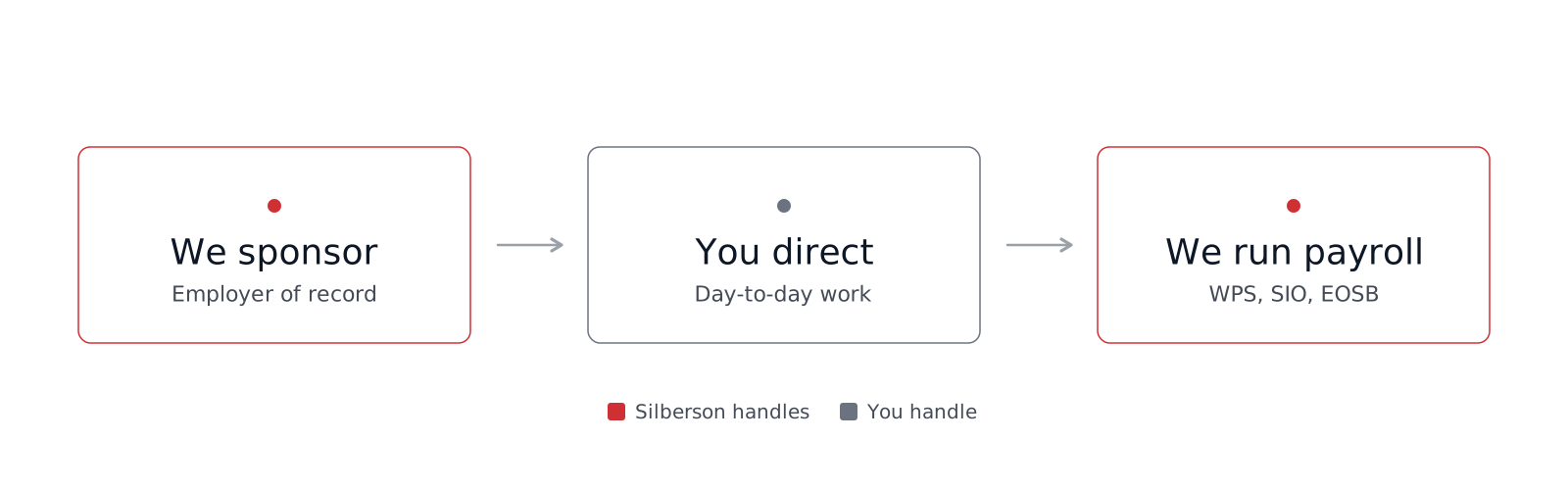
How a Bahrain Employer of Record works
Bahrain Employer of Record vs Entity setup
| Factor | Bahrain EOR | Local entity setup |
|---|---|---|
| Time to first hire | 21 working days from outside Bahrain · 3 working days from inside Bahrain | 2–4 months (company registration, licensing, CR) |
| Setup cost | No entity setup cost — service fee only | Company registration, legal fees, CR, office requirement |
| Compliance ownership | EOR manages LMRA, SIO, WPS, Labour Law | Company is directly liable for all compliance |
| Bahrainization | We manage your quota compliance | Company is directly responsible for quota compliance |
| Headcount flexibility | Scale up or down without restructuring | Headcount changes affect Bahrainization calculations directly |
| Best for | Testing the market, small teams, faster hiring, remote workforce expansion | Long-term operational presence, large workforce, licensed local operations |
Many companies start with an EOR model and move to a local entity once the market is proven. The EOR phase doesn’t block entity setup later. It buys time to make that decision with revenue data rather than assumptions.
Questions about entity setup in Bahrain? See our business setup services
How much does a Bahrain EOR cost?
There is no flat rate, because the cost depends on the employee, not on us. Four things set it: the salary you agree with the hire, which determines the SIO and EOSB contributions stacked on top; the work permit duration you choose; your current Bahrainization position, since a shortfall adds a surcharge to each new permit; and any benefits written into the contract.
On top of those statutory costs, we charge a monthly service fee per employee. That fee covers payroll processing, SIO filings, LMRA permit management, EOSB provisioning and day-to-day compliance. It does not change if the regulations change, because keeping up with those changes is our job.
To give you a real number instead of a range, we need four inputs: headcount, salary levels, the nationality mix of your hires, and the permit duration. Send those and we will model the full monthly cost with every statutory contribution included.
What Bahrain’s 2024–2026 compliance reforms mean for employers
In the past two years, Bahrain has restructured its employment compliance framework across payroll processing, EOSB funding, social insurance reporting, and workforce localization. The changes are not incremental. They require operational adjustments from every employer in the country.
Enhanced Wage Protection System (mandatory from February 2026)
Bahrain has mandated an Enhanced WPS for all private-sector employers. All salary payments must be processed through the LMRA WPS portal. Under the Enhanced WPS requirements, direct bank transfers to employees are not permitted. Employers must designate a Wages Responsible Person (WRP), assign maker and checker roles for payroll file preparation, and upload monthly payroll files using LMRA’s standardised format. Non-compliance blocks LMRA transactions, including new work permit applications and visa renewals.
EOSB contribution model (effective 1 March 2024)
Decision No. 109 of 2023, issued by Bahrain’s Crown Prince and Prime Minister in December 2023, restructured End of Service Benefit obligations for non-Bahraini employees. From 1 March 2024, employers contribute EOSB monthly through the Social Insurance Organisation (SIO) rather than accumulating a direct lump-sum liability. The SIO pays employees directly upon termination for service from March 2024 onwards. Employers remain directly responsible for EOSB accrued before 1 March 2024.
Bahrain employment compliance now runs through mandatory government platforms, contribution registries, and regulated payroll portals. HR awareness alone does not cover it.
What our Bahrain EOR service covers
As the legal employer for your Bahrain-based employees, we handle the compliance infrastructure. You direct the work. Our EOR service covers the full employment lifecycle.
How we deliver this
- Local employment sponsorship
- Compliant employment contracts (Arabic-language, LMRA-registered for expatriates)
- Work permit processing and LMRA / EMS coordination
- SIO registration for all employees
- Employee onboarding
- Payroll processing through the Enhanced WPS portal
- SIO contribution administration (Bahraini nationals and expatriates)
- EOSB administration, covering pre- and post-March 2024 periods
- Bahrainization quota management
- Leave management and leave calculations
- Employee offboarding and final settlement
Most global EOR platforms rely on local Bahraini partners to run these functions. We are that local partner – the employment infrastructure, payroll operations, and compliance management that international companies and global EOR providers build their Bahrain operations on.
Bahrain payroll compliance: WPS, Enhanced WPS, and SIO
Payroll in Bahrain now involves multiple government systems, each with its own filing requirements and timing obligations. Getting one wrong affects the others.
Enhanced WPS compliance (mandatory from February 2026)
All salary payments must be processed through the LMRA WPS portal under the Enhanced WPS framework. Salaries must exactly match the amount stated in the employment contract. Any salary change requires LMRA approval before the new amount can be processed.
Employers must:
- Designate a Wages Responsible Person (WRP) with advanced eKey authentication
- Assign maker and checker roles for payroll file preparation
- Upload monthly payroll files using LMRA’s standardised format
- Provide documented justification for any non-payment or partial payment
Non-compliance blocks LMRA transactions, including new work permit applications and visa renewals.
SIO contribution rates
The Social Insurance Organisation (SIO) is Bahrain’s statutory body responsible for employee social insurance, retirement contributions, and — since March 2024 — EOSB funding for expatriate employees. Contributions are calculated on a wage ceiling of BHD 4,000; salary above that amount is not counted.
| Employee type | Employer contribution | Employee contribution | Combined rate | Notes |
|---|---|---|---|---|
| Bahraini nationals (2026) | 18% | 8% | 26% | Employer share rises 1% per year to 20% by 2028. Ceiling: BHD 4,000. |
| Expatriate employees — work injury insurance | 3% | — | 3% | Employer bears this contribution alone (Article 47, Social Insurance Law). Ceiling: BHD 4,000. |
| Expatriate employees — unemployment insurance | — | 1% | 1% | Employee contribution. Separate branch from work injury. Ceiling: BHD 4,000. |
| Expatriate employees — EOSB (years 1–3) | 4.2% | — | 4.2% | Decision No. 109 of 2023, effective 1 March 2024. |
| Expatriate employees — EOSB (year 4+) | 8.4% | — | 8.4% | Applies from start of regulation for employees already past 3 years of service before 1 March 2024 (Article 13). |
For a full breakdown of the 2026 rate changes, see our Bahrain social insurance update.
We manage all SIO filings, salary data submissions, contribution audits, and compliance reviews. If wage data is not properly submitted, the SIO calculates contributions at a higher rate. That creates retroactive liability.
Work permits and LMRA compliance in Bahrain
The Labour Market Regulatory Authority (LMRA), established in 2006, regulates work permits, sponsorship, and expatriate employment in Bahrain. Employment contracts for expatriate employees must be registered through LMRA’s Expatriate Management System (EMS). Bahraini national employees are registered through SIO and do not require work permits.
Our LMRA support covers
- New work permit applications for expatriate employees
- Work permit renewals
- Employee sponsorship transfers
- Immigration coordination
- EMS registration and management
- Labour market compliance monitoring
Common LMRA compliance failures
- Delayed permit approvals from incomplete documentation
- WPS mismatches — salary paid must exactly match the LMRA-registered contract amount
- Sponsorship gaps during employee transitions
- LMRA transaction blocks from Enhanced WPS non-compliance
LMRA also charges a monthly fee per expatriate employee: BHD 7.5 per worker for the first five employees, BHD 12.5 per worker from the sixth onwards. These apply on top of permit fees for as long as the employee is sponsored. Levy amounts are set by LMRA regulation and subject to change.
Employer obligations under Bahrain Labour Law
Bahrain’s Labour Law (Law No. 36 of 2012) sets out employer obligations that many international companies underestimate when entering the market. Employment contracts must be in writing and in Arabic — bilingual contracts are permissible for expatriate employees, but the Arabic text governs.
Leave entitlements
| Leave type | Entitlement | Conditions | Article |
|---|---|---|---|
| Annual leave | 30 calendar days | After one year of continuous service | Article 58 |
| Maternity leave | 60 days paid | Full pay. Additional 15 days unpaid available on employee request (Article 32). | Article 32 |
| Paternity leave | 1 day paid | Statutory minimum — market practice typically exceeds this | Article 63(b) |
| Sick leave | 55 days per year: 15 days full pay, 20 days half pay, 20 days unpaid | After 3 months continuous service. Medical certificate required. Does not apply during probation. | Article 65 |
| Probation period | Maximum 3 months (up to 6 months for occupations designated by ministerial resolution) | Must be expressly stated in the employment contract. Cannot be imposed on the same employee more than once by the same employer. Sick leave and some other entitlements do not apply during probation. | Article 21 |
Overtime and working hours
Standard working hours are capped at 48 hours per week.
| Hours type | Minimum overtime rate | When it applies |
|---|---|---|
| Standard daytime overtime | 125% of regular hourly wage | Hours beyond standard working day |
| Night hours, Fridays, public holidays | 150% of regular hourly wage | 7pm to 7am (as defined by ministerial resolution under Article 54), Fridays, and Bahrain public holidays |
Health coverage
Primary healthcare access for expatriate employees is included in LMRA work permit costs. A Basic Health Care Fee is collected by LMRA at permit issuance and renewal. We include this in our EOR cost model and manage it on your behalf. Employers who arrange additional private health insurance for their workforce do so above this baseline.
Termination and severance
Employers must provide a minimum of 30 days’ written notice under Article 99, or payment in lieu. Before terminating for underperformance, employers must issue written notice of deficiencies and allow at least 60 days for improvement under Article 109. Where a termination is found to constitute unfair dismissal under Articles 104 or 105 — covering discrimination on grounds of sex, religion, nationality, pregnancy, trade union membership, whistleblowing, or dismissal during leave — the worker is entitled to an additional 50% of the standard compensation under Article 111(e). Courts may also order reinstatement where the grounds are trade union activity or employee representation.
| Contract type | Condition | Compensation | Notes |
|---|---|---|---|
| Indefinite contract | Termination without cause — after first 3 months of employment | 2 days’ wages per month of service · minimum 1 month’s wages · maximum 12 months’ wages | Article 111(b). No compensation applies during the first 3 months of employment unless termination is arbitrary. |
| Fixed-term contract | Termination without cause before end of term | Wages for remaining contract period. Where parties agree a lesser amount, minimum compensation is 3 months’ wages or the remaining period, whichever is less. | Article 111(c) |
| Any contract — unfair dismissal | Termination constitutes unfair dismissal under Articles 104 or 105 (discrimination, pregnancy, trade union activity, whistleblowing, dismissal during leave, attachment of wages) | Standard compensation above, plus an additional 50% of that amount. The employment contract may provide for a higher amount. | Article 111(e) |
Expatriate employees are entitled to a return travel ticket to their home country on termination, provided they are not taking up new employment in Bahrain.
Arabic employment documentation, termination records, payroll alignment, and performance management evidence are areas where international employers most often get caught out. We keep your practices aligned with Bahrain Labour Law and local enforcement expectations.
Bahrainization compliance
Bahrainization is Bahrain’s workforce localisation policy, requiring private-sector employers to meet sector-specific Bahraini national hiring targets. Quota rates vary significantly by sector, from approximately 5% to 90% depending on industry and business activity.
As your EOR partner, we manage your Bahrainization compliance position. We track your quota, support local hiring requirements, and keep your workforce within your sector’s target. Employers who fall short face a surcharge on new work permit applications and potential restrictions on permit approvals. Surcharge amounts are set by LMRA regulation.
Sector-specific Bahrainization targets
| Sector | Approximate Bahrainization target | Non-compliance consequence |
|---|---|---|
| Banking and financial services | 50% | Surcharge on new work permit applications. Amounts set by LMRA regulation |
| Retail | ~30% | Surcharge on new work permit applications. Amounts set by LMRA regulation |
| Other sectors | 5%–90% depending on activity | Surcharge on new work permit applications. Amounts set by LMRA regulation |
End of Service Benefit (EOSB) in Bahrain: what changed in 2024
Bahrain is the first GCC country to fully transition from a traditional lump-sum gratuity model to a government-funded, contribution-based EOSB system. Most international employers get this wrong when they first enter Bahrain.
| Period | EOSB mechanism | Who pays the employee | Employer obligation |
|---|---|---|---|
| Service before 1 March 2024 | Traditional lump-sum model | Employer — direct payment at termination | Calculate and pay directly: half month per year for years 1–3, one month per year thereafter (Article 116) |
| Service from 1 March 2024 onwards | SIO contribution model (Decision No. 109 of 2023) | SIO — pays employee directly upon termination | Monthly SIO contributions: 4.2% of wages (years 1–3), 8.4% (year 4+) |
The Article 13 rule for long-tenure employees
Employers with expatriate staff already in service before March 2024 often get this wrong. Decision No. 109 of 2023, Article 13 states that an employee who had worked for the same employer for more than three years before 1 March 2024 does not start at the 4.2% contribution rate. The applicable rate from day one of the regulation is 8.4%. The three-year clock does not reset.
An employee hired in January 2020 and still in post in March 2024 had completed four years of service. From March 2024, that employer owes 8.4% of wages monthly, not 4.2%. Employers who assumed the lower rate applied to all employees from that date are underpaying and accumulating a retroactive shortfall.
Managing the pre- and post-2024 EOSB split
For full detail on the 2024 EOSB transition, see our EOSB Guide.
Every termination now requires reconciliation across both periods. An employee hired in January 2022 and terminated in 2026 will have:
- Pre-March 2024 EOSB (24 months): employer pays directly as lump sum
- Post-March 2024 EOSB (24+ months): SIO pays the employee from the contribution fund
Salary reporting accuracy is critical. If wage data is not properly submitted to SIO, contributions are calculated at a higher rate. That creates retroactive liability.
Hiring timeline and common challenges for international employers
| Stage | What happens | Typical timeframe | Key requirement |
|---|---|---|---|
| 1. Candidate selection | Role defined, candidate identified | Varies | Salary agreed between employer and employee — no statutory floor in the private sector |
| 2. Permit application | Admin and advertisement fees paid to LMRA (BHD 30, non-refundable). 7-day newspaper vacancy advertisement published automatically by LMRA. | Day 1 | Arabic employment contract, EMS registration (expatriates), required documentation |
| 3. Processing period | LMRA reviews and processes the permit application | 21 working days (outside Bahrain) · 3 working days (inside Bahrain) | Nationality, occupation, and employer structure affect exact timing |
| 4. Work permit issued | Work permit fees paid, LMRA processing completed | After processing period | Permits are issued for 6 months, 1 year, or 2 years. A 2-year permit cuts renewal admin, but the Bahrainization surcharge scales with duration, so employers outside quota pay more for the longer option. |
| 5. Onboarding | Employee onboarded, WPS registration, payroll setup | 1–3 days post-permit | Salary in WPS must match registered employment contract amount exactly |
Common hiring challenges
- Sponsorship rule complexity
- Payroll setup and Enhanced WPS compliance
- Salary structuring aligned with LMRA-registered contracts
- EOSB calculations across pre- and post-March 2024 periods
- Arabic-language contract requirements
Why international companies use a local Bahrain partner
Most global EOR platforms operate on software infrastructure. Bahrain employment operations require local regulatory knowledge, Arabic documentation handling, LMRA and EMS coordination, payroll execution aligned with Enhanced WPS requirements, and SIO administration. None of which can be delivered from a distance.
We are the local Bahrain compliance and employment infrastructure partner for global EOR providers, multinational companies, staffing firms, remote hiring platforms, and international payroll providers.
Frequently asked questions — Bahrain EOR and employment compliance
International hiring in Bahrain requires more than software. It requires local execution across Enhanced WPS, post-Decision 109 EOSB, and current SIO requirements.
We help international companies and global EOR providers compliantly hire, sponsor, onboard, and manage employees in Bahrain through local infrastructure and direct regulatory expertise.