📋 Regularly updated | General guidance only
We review this article when Saudi Arabia’s visa policies change. Updates can be delayed — rules change without notice and human error can occur. This article is for general information only. Silberson is not a law firm. Nothing here constitutes legal or immigration advice. Always verify current requirements with the Saudi Ministry of Foreign Affairs or a qualified immigration professional before making any travel or compliance decisions.
Last reviewed: June 2026
Choosing the wrong visa for Saudi Arabia business travel is more common, and more consequential, than most companies realise.
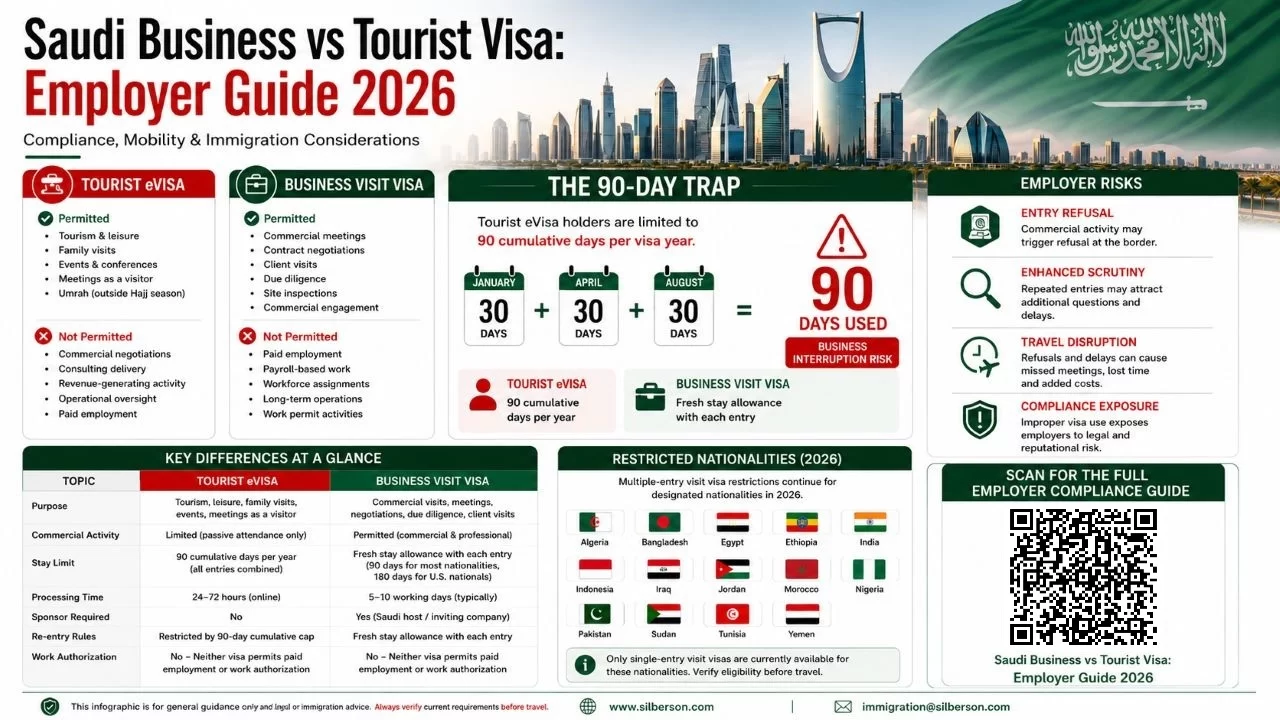
Saudi Arabia’s tourist eVisa is defined by official Ministry of Tourism regulations as a tourism instrument. The Business Visit Visa is the correct classification for commercial and professional activity. They are not interchangeable. The permitted activities differ substantially, the stay limits operate on different mechanics, and the consequences of misclassification fall on both the individual traveller and the employer directing the travel.
This guide covers what each visa permits, where companies go wrong, the 3-month cumulative stay rule that catches most corporate travellers off guard, and a free eVisa stay duration calculator to help HR and mobility teams track cumulative stay accumulation in real time.
What each visa actually permits
The tourist eVisa: a tourism instrument, not a commercial one
Available to nationals of 66 eligible countries, the Saudi tourist eVisa is issued online within 24 to 72 hours with no embassy visit required.
The official Saudi Ministry of Tourism Tourist Visa Regulations and the Visit Saudi eVisa Terms and Conditions define the eVisa explicitly as an instrument granted “solely for tourist purposes or for the purpose of performing Umrah.” Holders are required to stick to the main purpose for which the visa was granted and must not engage in any paid or unpaid work.
Permitted:
- Tourism, leisure, sightseeing
- Family visits
- Events and cultural activities
- Umrah pilgrimage outside the Hajj season
- Attendance at meetings and conferences as a passive visitor, accommodated under Vision 2030 policy, though not explicitly stated in the formal Terms and Conditions
Not permitted:
- Active commercial engagement, negotiations or contract work
- Site inspections in an operational capacity
- Any paid or unpaid work of any kind
The official Terms and Conditions confirm that “holding an eVisa does not guarantee entry to KSA. Entry shall remain at the discretion of an Immigration Officer.” Officers assess the nature of activities, not simply the visa type held.
The Business Visit Visa: the right classification for commercial travel
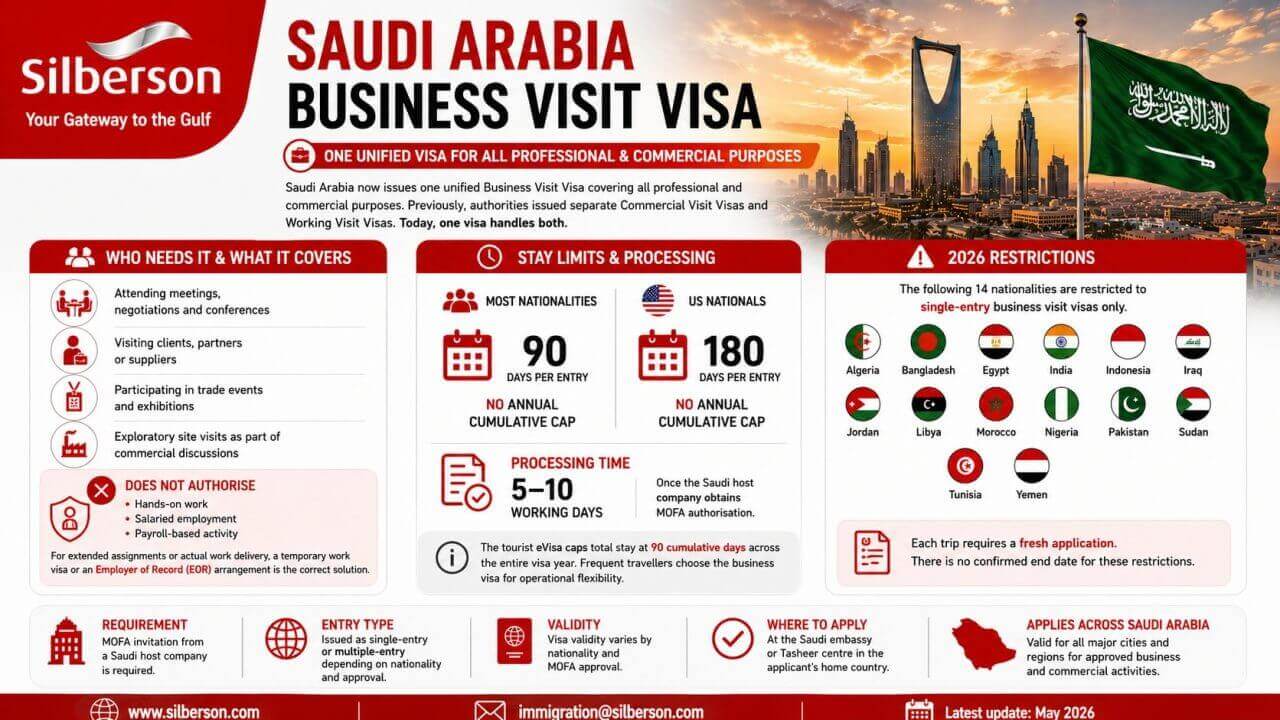
The Business Visit Visa covers the full range of commercial activity: client meetings, negotiations, due diligence, commercial discussions and ongoing business engagement.
The critical distinction beyond permitted activity is how the stay limit works.
A multiple-entry Business Visit Visa provides a fresh stay allowance on every entry — most nationalities receive 90 days per entry with no cumulative annual cap. US nationals benefit from up to 180 days per entry under bilateral arrangements. A regional manager making five Saudi trips per year faces no annual ceiling under a business visa. On a tourist eVisa, the same manager exhausts the 3-month cumulative allowance across all visits and cannot re-enter until the visa year resets.
One important boundary: the Business Visit Visa authorises commercial activity — meetings, negotiations, advisory visits and commercial discussions — but does not cover employment, hands-on work delivery or operational assignments. Where an engagement extends into actual employment, a work visa or temporary work visa, issued under sponsorship from your own Saudi entity, a Saudi client, or through a licensed employer of record provider, is the correct solution. (A separate guide covering the distinction between work visas and temporary work visas in Saudi Arabia is forthcoming.)
Why companies should think carefully about tourist visa usage
The compliance risk is rarely in any single trip. It sits in accumulated patterns of travel and in the absence of deliberate visa classification decisions.
The tourist eVisa permits attendance at meetings as a passive visitor. Officers generally interpret this with latitude for a first or isolated visit. It becomes a different assessment when an employee is making repeated entries to the same employer or commercial counterpart. The official position, confirmed by the Visit Saudi Terms and Conditions, is that entry remains at the officer’s discretion and the traveller must meet entry conditions on arrival.
The realistic compliance risks for employers are:
- Entry refusal at Saudi immigration: Officers may decline entry where the pattern of travel is inconsistent with tourist purposes. Refusals at Riyadh, Jeddah or Dammam airports are disruptive, costly and damage commercial relationships with the Saudi host.
- Project and relationship disruption: If a key commercial contact is refused entry at the start of a critical visit, the consequences extend well beyond that individual and that day.
- Reputational risk with the Saudi host: Entry refusals involving commercial visitors reflect directly on the sponsoring Saudi entity or partner.
Entry refusal is the realistic consequence for misclassified commercial travel. More serious outcomes are possible but represent escalation for systematic or prolonged violations, not the typical result of occasional misclassification.
When an employer directs an employee to travel for commercial purposes, the visa classification decision is not solely the individual traveller’s responsibility. HR and mobility teams that facilitate tourist visa usage for recurring commercially active employees are accepting an immigration risk that belongs on the company’s compliance register.
Saudi Arabia’s 3-month rule: two complications employers must understand
This is the most operationally significant aspect of the tourist eVisa, and the most consistently misunderstood. There are two distinct complications that affect travellers differently.
How the cumulative cap works
Section 7.3 of the official Visit Saudi eVisa Terms and Conditions states: “the maximum length of stay allowed under the eVisa is 3 months.”
This is not 3 months per visit. It is 3 months in total across all visits during the 365-day validity period. The UK Foreign, Commonwealth & Development Office confirms this directly in its Saudi Arabia entry requirements (updated June 2026): Saudi eVisas allow multiple entries, but are valid for “only for 90 days in total across the 365 day period.” The commonly cited “90 days” is the practical equivalent of the official “3 months” figure.
An employee who spends four weeks in January, four weeks in April and four weeks in August has exhausted their full annual allowance, with four months remaining on the visa. The official terms confirm: “if you are granted an eVisa, it cannot be extended.” There is no mechanism to reset, renew or extend the allowance during the visa year.
Complication 1: the lock-out and the invisible validity trap
Once the 3-month cumulative allowance is exhausted, a new tourist eVisa is not a reliable way back into the Kingdom while the existing eVisa remains valid, and reapplication should not be assumed to succeed. The only confirmed route back into the Kingdom before the visa year resets is a non-tourist visa: for example, a resident or family visit visa if eligible, or a sponsored Business Visit Visa requiring a MOFA invitation from a Saudi host entity and processing at the Saudi embassy or authorised visa application centre in the traveller’s home country, typically five to ten working days.
The invisible validity trap makes this worse in practice. The eVisa continues to show as “valid” because the 365-day validity period has not expired. Airlines verify only the validity date at check-in, not cumulative stay records. The traveller boards the flight without any system alert. The exhausted allowance becomes apparent only at Saudi immigration on arrival, not at the departure airport.
Example: A traveller receives their tourist eVisa on 1 January, valid until 31 December. They enter on 2 January and remain until the end of March, approximately 3 months. From April through to December, the visa document continues to show a future expiry date. The traveller can book flights and board without any system flag. On returning to Saudi Arabia in May, they reach Saudi immigration and are refused entry. The eVisa shows nine months of remaining validity on paper; the stay allowance has been fully used.
At the point of arrival in Saudi Arabia there is nothing that can be done. The traveller must arrange a Business Visit Visa and wait for processing before they can enter again.
Complication 2: the SAR 100 per day overstay fine
A separate and equally significant consequence applies when the 3-month cumulative allowance runs out while the traveller is already inside the Kingdom.
If a traveller enters Saudi Arabia with remaining cumulative days but stays beyond the total 3-month allowance, a fine of SAR 100 per day applies for each day beyond the permitted total — a figure confirmed in the U.S. State Department’s Saudi Arabia travel advisory. Fines are calculated at the exit counter (Jawazat) and must be settled before the traveller is cleared to depart. Travellers have paid fines running into several thousand riyals on departure, in cases where they entered with remaining days but stayed longer than their total cumulative allowance, assuming the “3-month stay period” applied per trip rather than in total.
Repeated or prolonged violations attract significantly higher penalties. In April 2025, Saudi Arabia’s Ministry of Interior announced that overstayers may face fines of up to SAR 50,000, imprisonment of up to six months, and deportation. These are escalation penalties for serious cases, but they confirm that the Saudi government treats overstay as a substantive violation.
The two scenarios at a glance:
| Situation | Consequence |
|---|---|
| 3 months exhausted before next entry attempt | Denied at Saudi immigration; eVisa shows valid on paper |
| 3 months exhausted while already in-country | SAR 100 fine per excess day, paid at departure (Jawazat) |
The realistic corporate scenario
The most common corporate trap is not a long stay. It is accumulated short trips that nobody is tracking centrally.
A senior business development manager makes regular Saudi trips across the year, each lasting one to two weeks, each individually reasonable. If those trips accumulate to 3 months by April or May, the manager has no further Saudi tourist entry available for the remaining seven or eight months of the visa year. This creates an invisible ceiling that travel departments struggle to track, individual travellers miss entirely, and which produces a hard operational stop at exactly the point where commercial relationships tend to be most active.
The tourist eVisa is operationally practical only for employees who travel to Saudi Arabia rarely: one or two genuinely isolated, short trips per year. Anyone travelling three or more times annually, or whose cumulative stay is likely to approach 3 months, should hold a Business Visit Visa from the outset.
Saudi eVisa stay duration calculator
There is no official Saudi government portal, app or tool for tracking remaining tourist eVisa days. Travellers and HR teams must track this themselves using passport stamps and travel records, with no automated warning from the Saudi system.
Use this free eVisa stay duration calculator to track cumulative stay accumulation against the 3-month annual allowance. Enter your eVisa issue date and add each trip to Saudi Arabia. The calculator shows total days used, remaining allowance, and the current compliance status of your eVisa.
When the Business Visit Visa is the right classification
The Business Visit Visa is the correct instrument for:
Commercial negotiations: Employees attending meetings specifically to negotiate contracts, pricing, commercial terms or partnership arrangements. Active negotiation is commercial activity, not passive visitor attendance.
Repeated executive travel: Senior leadership making repeated commercial visits for client oversight, board-level engagement or business relationship management. Frequency and commercial purpose create cumulative misclassification exposure when tourist entries are used repeatedly.
Long-term business development: Employees making multiple trips across a year to develop client relationships, pursue commercial opportunities or manage ongoing programmes, regardless of whether any individual trip involves a signed contract.
The practical test: if the purpose of the trip serves the company’s commercial interests in Saudi Arabia, the Business Visit Visa is the correct classification.
Where hands-on work or employment-type assignments are involved, a work visa or temporary work visa, under sponsorship from the traveller’s own Saudi entity, a Saudi client, or through a licensed employer of record provider, is required. (A further guide on Saudi work visa types is forthcoming.)
Saudi Business Visit Visa requirements
Obtaining a Business Visit Visa requires a Saudi-based host entity to initiate the process. The visa cannot be applied for independently.
The MOFA invitation: The sponsoring Saudi company submits a visa invitation through the Ministry of Foreign Affairs portal. Once approved, the host receives a MOFA authorisation number. The applicant then presents this, along with supporting documents, at the Saudi embassy or authorised visa application centre in their home country. MOFA processing delays on the Saudi side are consistently the most common source of overall business visa delays.
Standard documentation typically includes:
- Valid passport with at least six months remaining validity and two blank pages
- MOFA invitation authorisation number from the Saudi host
- Completed visa application form
- Passport-sized photographs to Saudi specifications
- Proof of accommodation and return travel
- Health insurance valid in Saudi Arabia
- Employer letter confirming commercial purpose of travel, where required
Requirements vary by nationality and processing post. Confirm directly with the relevant Saudi embassy or application centre before submitting.
eVisa issuance: The Business Visit Visa is now issued in eVisa format across Saudi embassies globally. Despite the electronic format, the process continues to require physical attendance: applicants appear in person for biometric data collection and original passport submission. The issued eVisa is provided as a printed document bearing the issuing embassy’s details, rather than a sticker in the passport. The documentation and in-person attendance requirements are unchanged from the previous stamp-based process.
For tourist eVisa holders, biometrics are captured on arrival in Saudi Arabia. For Business Visit Visa applicants, biometrics form part of the application process at the embassy or application centre before travel.
Processing and planning
Standard timeline: Five to ten working days from embassy or application centre submission. MOFA invitation processing adds further lead time before the application stage begins. Plan for a minimum of two to three weeks from initiating the MOFA invitation to receiving the issued eVisa. Business visa processing is not an emergency resource to reach for after tourist options are exhausted; it must be built into project planning from the outset.
Multiple-entry access: Where available, multiple-entry visas eliminate the need for a fresh MOFA invitation for every trip. Multiple-entry access is currently restricted for a significant number of nationalities.
2026 nationality restrictions
From February 2025, Saudi Arabia restricted multiple-entry visit visas for 14 nationalities, initially linked to Hajj season management. The restrictions were not lifted after the 2025 season and continue into 2026 with no confirmed reinstatement date.
Affected nationalities: Algeria, Bangladesh, Egypt, Ethiopia, India, Indonesia, Iraq, Jordan, Morocco, Nigeria, Pakistan, Sudan, Tunisia and Yemen.
For nationals of these countries, only single-entry visas are currently being issued. Each Saudi trip requires a fresh MOFA invitation and a new embassy or application centre appointment. Practitioners report that additional nationalities beyond the original 14 have been affected as restrictions have evolved. Always verify current status directly with the Saudi embassy before initiating any application.
During Hajj season, visit visa issuance for affected nationalities may face additional restrictions or temporary suspension.
Best practices for employers
Establish a written visa classification policy. Define which activities require a Business Visit Visa and what may appropriately be covered by tourist entry. Do not leave this to individual employees or last-minute judgement.
Track cumulative stay days centrally. There is no official Saudi tracking tool. HR or the mobility team must maintain records using passport stamps and travel bookings. Self-monitoring by individual travellers is not reliable at scale.
Identify high-frequency travellers at the start of each year. Employees making three or more Saudi trips annually should be assessed for Business Visit Visa classification regardless of individual trip length.
Build visa processing into project plans. Two to three weeks from MOFA invitation to issued eVisa is the realistic minimum. Mobilisation timelines that ignore this will fail under operational pressure.
Manage affected-nationality staff as a separate workflow. Every Saudi trip requires individual processing for restricted nationalities. Build this into project staffing and travel scheduling from the outset.
Key differences at a glance
| Tourist eVisa | Business Visit Visa (multiple entry) | |
|---|---|---|
| Official classification | Solely for tourist purposes (official T&C) | Commercial activity instrument |
| Commercial activity | Passive visitor attendance only | Full commercial engagement permitted |
| Work | Prohibited — paid and unpaid (official T&C) | Commercial meetings permitted; employment requires work visa |
| Visa validity | 1 year | 1 year (up to 5 years for some nationalities) |
| Maximum stay | 3 months cumulative across entire 365-day year | Fresh allowance per entry (90 days most nationalities; 180 days US) |
| Can be extended | No — explicitly stated in official T&C | Multiple-entry; no extension needed |
| After 3 months used | Lock-out for rest of visa year; SAR 100/day if already in-country | Re-enter with fresh allowance each trip |
| Cost | Approx. SAR 535 (~USD 143) incl. health insurance | Govt fee approx. SAR 300; typical all-in approx. SAR 700+ with service-centre fees, higher for some nationalities |
| Processing | 24–72 hours online | 5–10 working days; 2–3 weeks total pipeline |
| Sponsor required | No | Yes — MOFA invitation from Saudi host |
| Visa format | eVisa; biometrics on arrival in KSA | eVisa (printed from embassy); biometrics at application stage |
| Restricted nationalities | Single entry only (14+ nationalities) | Single entry only (14+ nationalities) |
Frequently asked questions
1. When should I use a Business Visit Visa rather than a tourist visa?
Any time an employee travels to Saudi Arabia to conduct commercial activity on behalf of the employer. The official tourist eVisa Terms and Conditions define the eVisa as “solely for tourist purposes.” The practical test: if the trip serves the company’s commercial interests in Saudi Arabia, the Business Visit Visa is the correct classification. The tourist eVisa is appropriate only for genuinely isolated, non-recurring visits with no active commercial mandate.
2. Can employees attend business meetings on a Saudi tourist visa?
Attendance at meetings and conferences as a passive visitor has been accommodated under Vision 2030 policy. Introductory or informational attendance falls within a reasonable interpretation of this allowance. Active commercial engagement — negotiations, managing client relationships, directed commercial work — goes beyond passive visitor attendance and requires a Business Visit Visa. The formal Terms and Conditions define the eVisa as “solely for tourist purposes” and confirm entry remains at the officer’s discretion.
3. What is Saudi Arabia’s tourist visa 3-month rule, and why does it catch so many travellers?
Per Section 7.3 of the Visit Saudi eVisa Terms and Conditions, confirmed by the UK Foreign, Commonwealth & Development Office’s Saudi Arabia entry requirements, the tourist eVisa permits a maximum stay of 3 months (approximately 90 days) across the entire 365-day validity period. This is not 3 months per visit — it is 3 months in total across all visits combined. The reason it catches travellers is that the eVisa documentation refers to a “3-month stay period,” which many read as applying per entry. An employee who makes several short trips in the first few months of the year can exhaust the full annual allowance well before the summer.
4. What happens when the tourist eVisa 3-month allowance is exhausted?
Two distinct scenarios apply:
If exhausted before the next entry attempt: The eVisa continues to show as “valid” but entry will be refused at Saudi immigration on arrival. Airlines check validity dates, not cumulative stay records, so the traveller will board without any system flag. At Saudi immigration the exhausted allowance is identified and entry is refused. The only confirmed route back into the Kingdom is a sponsored Business Visit Visa, requiring a MOFA invitation and typically five to ten working days of processing.
If exhausted while already inside Saudi Arabia: A fine of SAR 100 per day applies for each day beyond the cumulative 3-month limit, as confirmed in the U.S. State Department’s Saudi Arabia travel advisory. Fines are calculated at the departure counter (Jawazat) and paid before the traveller can board. Repeated or prolonged overstays can attract significantly higher penalties. Saudi Arabia’s Ministry of Interior announced in April 2025 that overstayers may face fines of up to SAR 50,000, imprisonment of up to six months, and deportation in serious cases.
5. How do I calculate remaining tourist eVisa stay days?
There is no official Saudi government portal, app or calculator for checking remaining eVisa days. Travellers and HR teams must track this themselves.
The calculation: add up all days spent inside Saudi Arabia across all visits since the eVisa was issued, counting both the arrival and departure day for each trip. Entry and exit dates from passport stamps or booking records are the reference points.
Some immigration officers have verbally cautioned travellers entering with very few days remaining, but this is inconsistent and not a government obligation. Travellers should not rely on being warned at the border. Use the calculator above to track your cumulative stay accumulation for each eVisa year.
6. My employee’s tourist eVisa still shows as “valid” — does that mean they can enter?
Not necessarily. A tourist eVisa showing a future expiry date does not indicate how many stay days remain. If the traveller has used the full 3-month cumulative allowance, the eVisa is effectively unusable for entry — even though it continues to display as valid in any document check, and even though airlines will allow boarding.
Example: a traveller receives their eVisa on 1 January (valid until 31 December) and stays from 2 January through to the end of March. From April, the visa continues to show as valid. The traveller books flights, checks in and boards without any system flag. On arrival at Saudi immigration, the exhausted allowance is identified and entry is refused.
HR and travel teams must track cumulative days independently. The visa document validity date is not an indicator of remaining entry entitlement.
7. Which nationalities face restrictions on Saudi business and tourist visas in 2026?
From February 2025, Saudi Arabia suspended multiple-entry visit visas for 14 nationalities: Algeria, Bangladesh, Egypt, Ethiopia, India, Indonesia, Iraq, Jordan, Morocco, Nigeria, Pakistan, Sudan, Tunisia and Yemen. The restrictions have continued into 2026 with no confirmed reinstatement date. Only single-entry visas are currently being issued for these nationalities. Each trip requires a fresh MOFA invitation and a new embassy appointment. Practitioners report that additional nationalities may also be affected. Always verify current status directly with the Saudi embassy.
8. Do employees need an invitation letter for a Saudi business visa?
Yes. A Business Visit Visa cannot be applied for without a MOFA invitation from a Saudi host company or entity. The Saudi host submits the invitation through the Ministry of Foreign Affairs portal, receives an authorisation number, and the applicant presents this at the Saudi embassy or authorised application centre, along with supporting documents. The MOFA invitation stage is consistently where delays originate. The overall pipeline from invitation request to issued eVisa is two to three weeks in most cases. If you are unsure how to obtain a MOFA invitation or what is required for your specific situation, contact Silberson’s KSA team for guidance.
9. What is the best visa option for frequent corporate travellers to Saudi Arabia?
For employees making three or more Saudi trips per year, or those whose cumulative stay is likely to approach 3 months, the Business Visit Visa (multiple-entry where available) is the correct choice. The tourist eVisa is practical only for employees who travel rarely: one or two short, genuinely isolated trips per year. For anyone else, the 3-month cumulative cap creates a hard annual ceiling that will disrupt travel at the worst possible moment.
10. What are the compliance risks of using the wrong visa category?
Using the tourist eVisa for commercial activity creates two categories of risk: enforcement risk for the individual and liability risk for the employer.
For the individual: the realistic consequences are refusal of entry at Saudi immigration and, in cases of sustained misclassification, deportation and future entry restrictions. The official Terms and Conditions confirm entry remains at the officer’s discretion and officers assess both the purpose and pattern of travel.
For the employer: project disruption when key commercial contacts are refused entry, reputational damage with Saudi hosts and partners, and overstay fines when employees miscalculate remaining cumulative days.
The most common corporate compliance failure is defaulting to the tourist eVisa because it is faster and cheaper to obtain, without making the classification assessment that each trip should require.
Working with Silberson
Visa misclassification, exhausted tourist allowances and restricted-nationality complications arise repeatedly in companies that have not built structured Saudi travel compliance into their mobility programmes.
Silberson’s corporate immigration and global mobility team provides support for companies managing Saudi Arabia business travel: Business Visit Visa coordination, MOFA invitation management, cumulative stay tracking, nationality-specific guidance and internal policy development. For companies with employees from restricted nationalities, we provide structured support for sequencing individual visa applications and managing administrative lead times.
Contact our KSA team to arrange a compliance review of your Saudi business travel programme, or to discuss the right visa strategy for your specific situation.
Disclaimer: This article is for general guidance only and does not constitute legal or immigration advice. Saudi Arabia’s visa policies change frequently and without prior notice. Silberson is not a law firm and makes no warranty as to the accuracy or currency of this information and accepts no liability for decisions made on its basis. Always verify current requirements with the official Saudi Ministry of Foreign Affairs at visa.mofa.gov.sa, your nearest Saudi embassy, or a qualified immigration professional before travelling.